
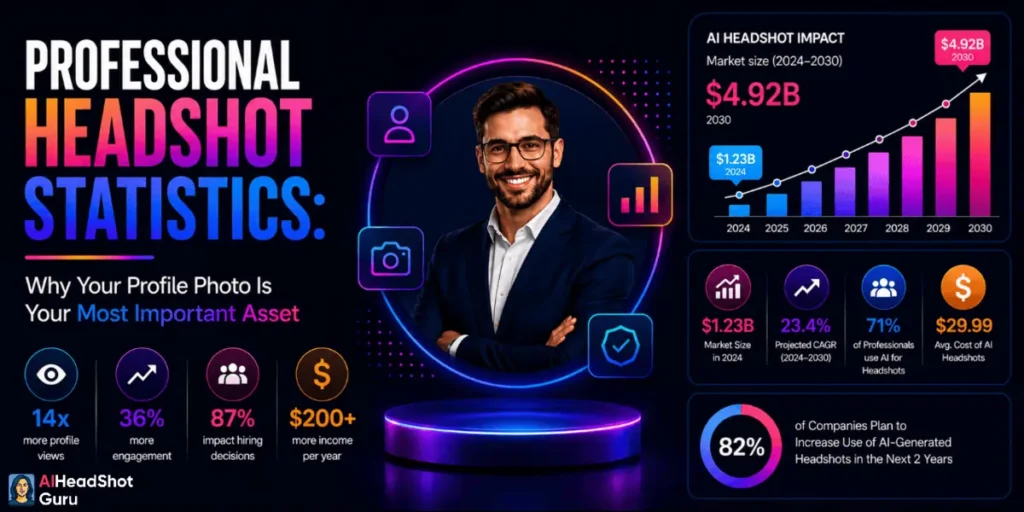
Your profile photo works harder than your resume, cover letter, and portfolio combined. One image in a 168×168 pixel circle decides if a recruiter clicks your name or scrolls past.
Professional headshot statistics for 2026 show profiles with pro photos get 21x more views, up to 36x more messages, and a 76% competence boost.
A Princeton study found people form first impressions in under 100 milliseconds — before anyone reads your headline.
With 86% of recruiters screening profiles in 30 seconds or less, your headshot isn't the first thing they see. It's often the only thing that makes them stay.
Key Professional Headshot Statistics 2026: Career-Defining Numbers
| Statistic | Data Point | Impact Level |
|---|---|---|
| Profile views with a photo | 21x more than profiles without | Critical |
| Messages received with a photo | Up to 36x more | Critical |
| Connection requests with a photo | 9x more | High |
| Perceived competence boost | +75.93% with a pro photo | High |
| Recruiters who rejected based on photo | 70% have done it | High |
| All-Star profiles getting opportunities | 40x more likely | Critical |
| Profiles appearing in LinkedIn search | 18x more likely with photo | High |
| First impression formed in | Under 100 milliseconds | Foundational |
| Recruiters screening in 30 seconds | 86% | Foundational |
| Pros who need a headshot for LinkedIn | 47% | Moderate |
| AI headshots on LinkedIn (2023–2025) | +38% increase | Growing |
| Photo refresh rate (past 12 months) | 34% (up from 22% in 2022) | Growing |
| Recruiters planning more AI use in 2026 | 93% | Growing |
| Job seekers using AI in applications | ~65% | Growing |
The LinkedIn Headshot Multiplier Effect
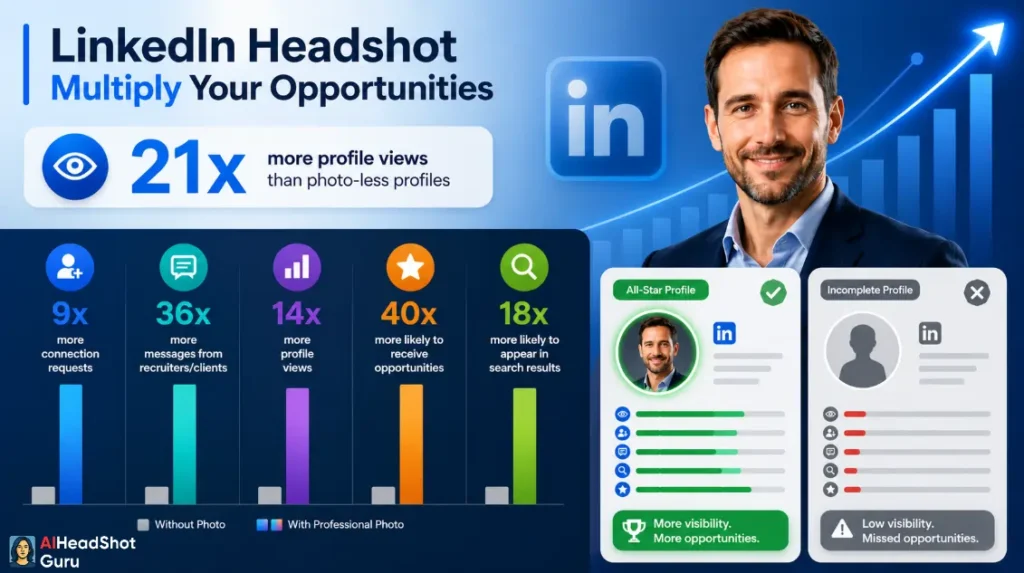
Most professionals treat their LinkedIn photo as an afterthought — a quick selfie, a cropped wedding photo, or worse, nothing at all. The professional headshot statistics say that's career sabotage.
Profiles with professional photos receive 21 times more views than photo-less profiles. Not 21% — 21x. That's the gap between being found in recruiter searches and being invisible.
The engagement multipliers stack fast:
LinkedIn designed its algorithm to surface profiles with photos. The photo requirement for All-Star status isn't arbitrary — it's a quality signal the platform uses to rank credible profiles higher in search results.
Skip the photo, and you're telling LinkedIn's algorithm you don't care about your profile. The algorithm returns the favor by burying you.
First Impressions Happen Before Anyone Reads a Word
A Princeton University study found that people form trait judgments — attractiveness, likeability, trustworthiness, competence — after just 100 milliseconds of exposure to a face. Extending the viewing time to 500ms or even 1,000ms didn't change the judgments; it only made people more confident in their snap decisions.
Harvard professor Amy Cuddy's 15-year research on first impressions found that every interaction boils down to two unconscious questions:
- Can I trust this person?
- Are they competent?
Your headshot answers both in a fraction of a second. An open expression and direct eye contact signal trust. Upright posture and polished attire signal competence. A bad photo fails both tests before your headline loads.
77% of recruiters specifically look at the application photo before anything else, according to a University of Bamberg study.
The photo creates a halo effect — when the image makes a positive impression, the rest of the profile gets read more favorably. When it doesn't, recruiters set the application aside faster.
What Recruiters Actually Do With Your Photo
Here's the part that should make anyone with a blurry selfie for a profile picture uncomfortable.
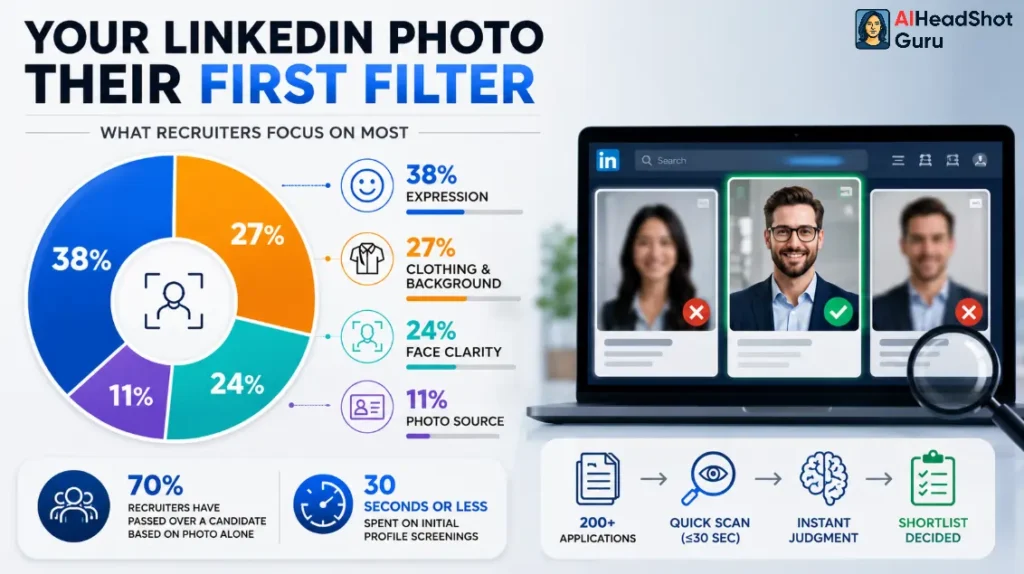
70% of recruiters have passed over a qualified candidate based on their LinkedIn photo alone. Not their skills. Not their experience. The photo.
86% of recruiters and hiring managers spend 30 seconds or less on initial profile screenings. In that half-minute, your headshot serves as the primary visual anchor for split-second judgments about professionalism, cultural fit, and attention to detail.
Recruiters evaluate headshots on a checklist most candidates never see:
A recruiter processing 200+ applications for a single role uses every available signal to build a shortlist fast. Your headshot becomes a proxy for professionalism. Fail the visual test, and your qualifications never enter the conversation.
The Psychology Behind Why Photos Control Hiring Outcomes
The human brain processes images 60,000 times faster than text. Before a recruiter reads your job title, they've already assessed your photo for trustworthiness, competence, and approachability.
This isn't superficial — it's evolutionary. Psychologists argue that humans learn to read intentions, trustworthiness, and status from a glance at someone's face as early as childhood. That instinct carries directly into professional hiring decisions.
75% of hiring professionals research candidates' social profiles before making hiring decisions. Your headshot appears in every single one of those checks — LinkedIn, Twitter, company websites, speaker bios, email signatures. One weak photo creates doubt across every platform where a recruiter finds you.
88% of job seekers believe a polished digital presence influences hiring decisions. The belief matches the behavior on both sides of the hiring table — candidates know it matters, and employers act on it.
Personal branding is associated with 70% higher odds of professional opportunity across career research. Your headshot is the visual anchor of your personal brand and the first element most people see in every context where your brand appears.
The ROI of Professional Headshots: What the Numbers Say
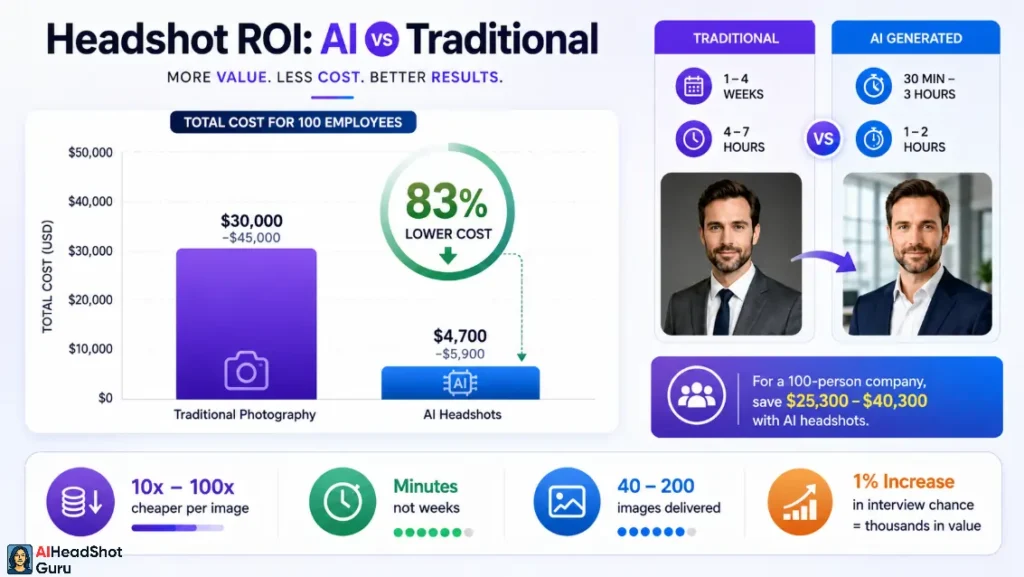
Let's talk money. The professional headshot statistics for 2026 show a clear financial return on a tiny investment.
Traditional vs. AI Headshot Costs
| Factor | Traditional Photographer | AI Headshot Generator |
|---|---|---|
| Session cost | $150–$450 | $29–$79 |
| Images delivered | 5–15 | 40–200 |
| Cost per usable image | $30–$100 | $0.50–$3.00 |
| Turnaround time | 1–4 weeks | 30 minutes–3 hours |
| Total time investment | 4–7 hours | 1–2 hours |
| Enterprise cost (100 employees) | $15,000–$45,000 | $3,500–$5,900 |
The math is brutal. Traditional photography costs 10 to 100 times more per image than AI-generated headshots.
For a 100-person company, switching to AI headshots produces an average 83% cost reduction per employee.
For individual professionals, the ROI calculation is straightforward: if a professional photo increases your likelihood of landing an interview by even 10%, and that interview leads to a job offer worth $5,000–$10,000 more in annual salary, a $29–$79 headshot investment pays for itself many times over.
AI Headshot Adoption: The 2026 Shift
The AI headshot market crossed from niche experiment to mainstream professional tool. Here's what the professional headshot statistics show about adoption:
The photo refresh rate tells the story: 34% of LinkedIn users updated their profile photo in the past 12 months, up from 22% in 2022. AI tools were the most-cited reason.
Lower cost and friction means more frequent updates, which means profiles stay current instead of running on two-year-old photos that no longer match how the person looks.
Can Recruiters Tell If Your Headshot Is AI-Generated?
Here's where the data gets interesting — and counterintuitive.
In blind studies where recruiters evaluated headshots without knowing their origin:
The quality of the headshot matters far more than how it was produced. A poor-quality AI headshot damages credibility the same way a poor-quality traditional photo does.
A high-quality AI headshot performs at least as well as a high-quality studio photo for every standard professional context.
The Trust Factor
When recruiters were told a photo was AI-generated, 28% said it made them slightly more cautious. But 41% said it made no difference, and 31% were neutral.
66% of recruiters report decreased trust when an AI photo misrepresents the candidate — meaning the issue isn't AI vs. traditional, it's accuracy vs. inaccuracy.
Headshot Quality: What Actually Breaks Your Profile
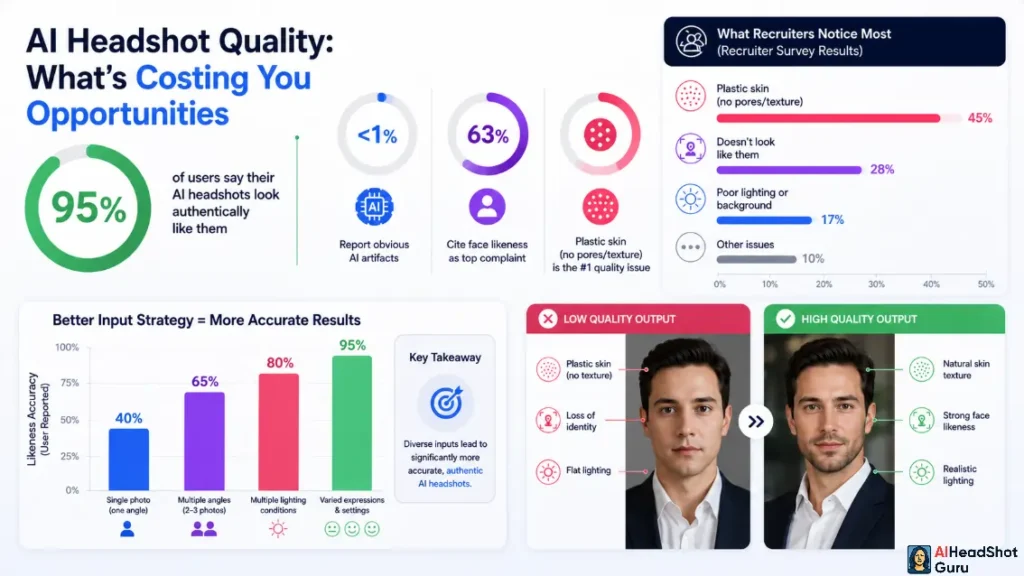
The professional headshot statistics reveal specific failure modes that cost people opportunities without them ever knowing:
Face likeness problems trace to input photo strategy. Users who provide diverse angles, multiple lighting conditions, and varied expressions produce significantly more accurate results. The tool quality matters — and so does the input.
Common Headshot Mistakes That Kill Your Credibility
Recruiters won't tell you why they passed. But the professional headshot statistics identify the specific photo mistakes that trigger rejection:
Mid-chest framing impacts job acceptance rates by 47% compared to poorly framed photos, based on LinkedIn analysis. Composition isn't cosmetic — it's measurable in hiring outcomes.
How to Use Professional Headshot Statistics to Boost Your Profile
The data points to a clear playbook. Here's what the numbers say works:
The Business Case for Teams
For companies, the professional headshot statistics make the case even harder. Organizations using AI headshots for team pages report:
For a 200-person company, the difference between traditional photography and AI headshots is a five-figure budget vs. a four-figure one — with no measurable quality difference in blind recruiter evaluations.
Frequently Asked Questions About Professional Headshots
How many more views does a LinkedIn profile get with a professional photo?
Profiles with professional photos receive 21 times more views than profiles without photos, plus 9x more connection requests and up to 36x more messages from recruiters and potential clients.
What percentage of recruiters reject candidates based on their photo?
70% of recruiters have passed over a qualified candidate based on their LinkedIn photo alone, and 86% screen profiles in 30 seconds or less — meaning the photo often makes the first cut.
How fast do people form a first impression from a headshot?
A Princeton study found people form trait judgments after just 100 milliseconds of exposure to a face, and increasing viewing time only made people more confident in their initial snap decision.
Can recruiters tell if a headshot is AI-generated?
In blind tests, recruiters correctly identified AI headshots only 34% of the time — barely above random chance — and 74% rated AI headshots as “professional” or “highly professional.”
How much does a professional headshot cost in 2026?
Traditional photography sessions cost $150–$450 for 5–15 images, while AI headshot generators cost $29–$79 for 40–200 images — a 10 to 100x per-image cost advantage.
Is it worth getting a professional headshot?
Yes — profiles with professional photos get 21x more views, 36x more messages, and a 76% competence boost, making a $29–$79 investment one of the highest-ROI career moves available.
How often should you update your professional headshot?
Career experts recommend updating every 2–3 years or after significant appearance changes, and 34% of LinkedIn users updated their photo in the past 12 months — up from 22% in 2022.
Conclusion: Your Profile Photo Is Working Right Now — For or Against You
The professional headshot statistics for 2026 leave no room for debate. Your profile photo is the single highest-leverage element of your professional presence. It generates 21x more views, 36x more messages, and a 76% competence boost — or it does the opposite.
Every recruiter search, every profile view, every cold email with your headshot in the signature — the photo is working for you or against you right now.
The professionals winning in 2026 treat their headshot as a living, maintained asset. They update more frequently. They maintain consistency across platforms.
They focus on what recruiters actually evaluate — expression, clothing, clarity — rather than worrying about questions that don't rank in recruiter decision-making.
The data is clear. The only question left is what you're doing about it.