

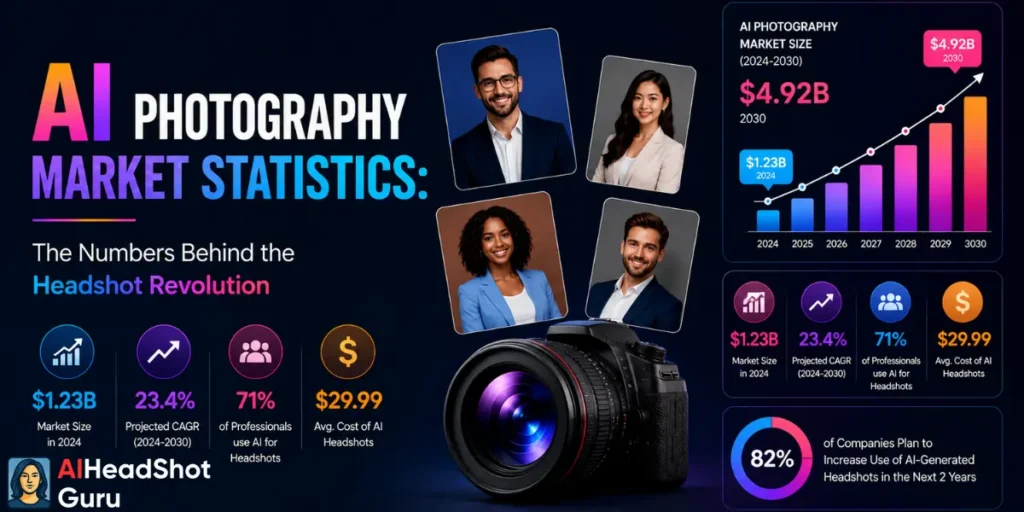
The AI photography market isn't coming — it's already here, already big, and already pulling serious money. From AI headshot generators processing millions of portraits to product photography tools slashing studio costs by 70%, the numbers in 2026 tell a story that most people are still sleeping on.
This data-driven breakdown covers the AI photography market size, portrait generator growth, headshot industry revenue, eCommerce photo adoption, geographic splits, and where the money is heading through 2034.
AI Photography Market Statistics 2026: Key Numbers at a Glance
| Metric | Data Point |
|---|---|
| AI Photo Editors Market Size (2024) | $2.1 Billion |
| AI Photo Editors Market Projection (2034) | $8.9 Billion |
| AI Photo Editors CAGR | 15.7% (2024–2034) |
| AI Image Editor Market (2024) | $7.77 Billion |
| AI Image Editor Market Projection (2032) | $66.65 Billion |
| AI Image Editor CAGR | 30.92% (2025–2032) |
| AI Product Photography Market (2024) | $450 Million |
| AI Product Photography Market Projection (2035) | $5 Billion |
| AI Product Photography CAGR | 24.5% |
| AI Portrait Generator Market (2025) | $2.03 Billion |
| AI Portrait Generator Market Projection (2035) | $12 Billion |
| AI Portrait Generator CAGR | 19.4% |
| AI Headshot Market (2025) | $350–$420 Million |
| AI Headshot Market Projection (2028) | $640 Million |
| AI Headshot CAGR | ~15% |
| AI Camera Market (2026) | $18.96 Billion |
| AI Camera Market Projection (2034) | $82.45 Billion |
| North America AI Market Share | 36%+ of global revenue |
| Daily AI-Generated Images | ~34 Million/day |
| Total AI Images Created Since 2022 | 15+ Billion |
How Big Is the AI Photo Editors Market Right Now?
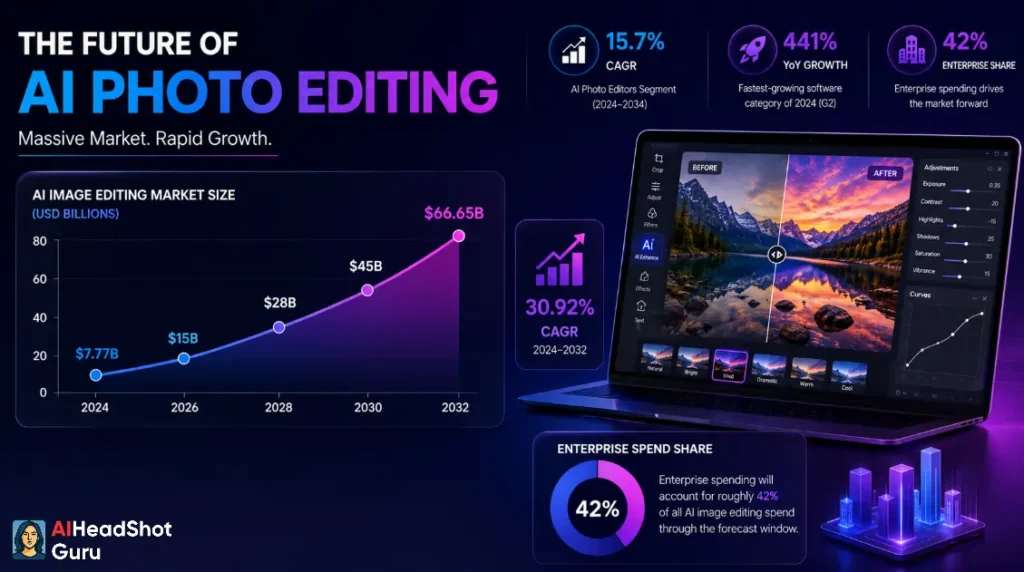
The AI photo editors segment hit $2.1 billion in 2024 and is on track to reach $8.9 billion by 2034 at a 15.7% CAGR, according to Emergen Research. That's not the ceiling — it's just the floor.
Zoom out to the full AI image editor category and the numbers get wilder. The market was valued at $7.77 billion in 2024 and is projected to hit $66.65 billion by 2032 — a jaw-dropping 30.92% CAGR.
For context, AI image editing was the fastest-growing software category of 2024 with 441% year-over-year growth in G2 listings and traffic.
Enterprise users are driving a significant chunk of this. Forecasts indicate enterprise spending will account for roughly 42% of all AI image editing spend through the forecast window, as large retailers managing thousands of SKUs automate their entire photography pipelines.
AI Product Photography Market: From $450M to $5 Billion
The AI product photography market grew from $450 million in 2024 and is forecast to reach $5 billion by 2035 — a 24.5% CAGR that makes it one of the fastest-expanding niches inside the broader AI creative market.
What's behind it? Three hard operational problems:
The ROI data backs the adoption. 87% of retailers using AI report annual revenue uplifts. Conversion rates jump 3x when AI imagery is properly implemented. AI on-model fashion imagery alone drives 60% conversion rate increases in tested campaigns.
North America led product photography AI adoption with a market valuation of $201 million in 2024, projected to reach $2.176 billion by 2035.
Europe clocked in at $465 million for AI-generated photo editing in 2024. Asia-Pacific shows the highest growth velocity, with APAC businesses leapfrogging traditional photography infrastructure entirely.
AI Portrait Generator Market: 19.4% CAGR Through 2035
The AI portrait generator market sat at $2.03 billion in 2025 and is expected to reach $12 billion by 2035, posting a 19.4% CAGR according to WiseGuy Reports.
The portrait-specific segment is growing faster than most people realize because it targets a universal, evergreen need — professional-looking photos of real people.
Earlier forecasts cited a more conservative 12% CAGR for 2026–2033, but updated market data now places growth closer to 19–20% as enterprise adoption accelerates and use cases expand beyond LinkedIn headshots into team directories, ID verification, real estate profiles, healthcare portals, and creator content.
The top five AI headshot platforms alone processed over 48 million portrait sessions in 2025 — and HeadshotPro reported generating over 17.9 million headshots as of early 2026.
AI Headshot Industry: Market Size, Adoption & Real Data
Market Size
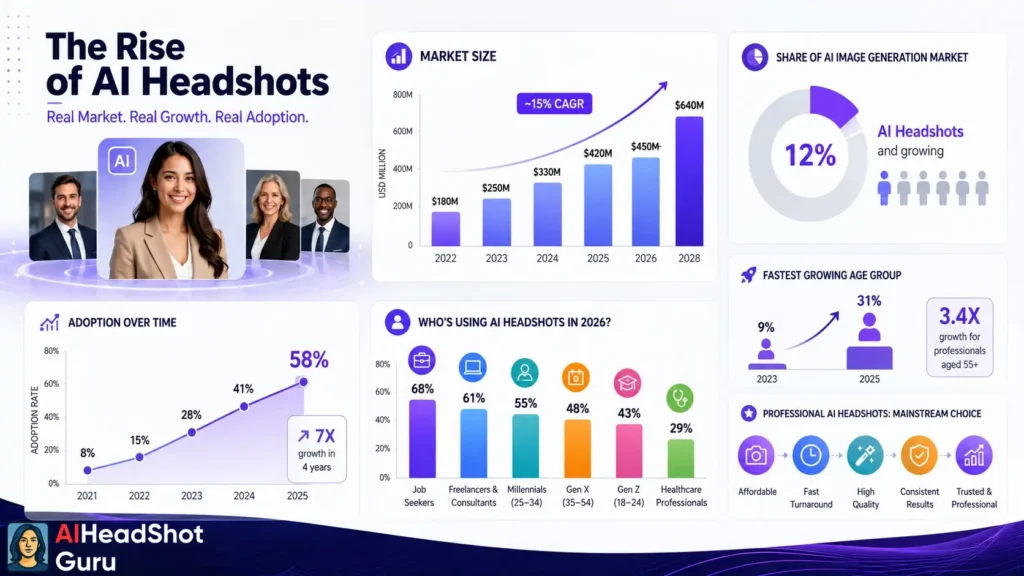
The AI headshot and professional portrait market exceeded $420 million in 2025, up from $180 million in 2022 — more than double in three years. Projections for 2026 put the market above $450 million, with a trajectory toward $640 million by 2028 at approximately 15% CAGR.
AI headshots now represent roughly 12% of the broader AI image generation market by revenue, and that share is growing as the segment matures from novelty to mainstream professional tool.
Who's Using AI Headshots in 2026?
Professional Adoption Over Time
AI headshot adoption grew from 8% in 2021 to 58% in 2025 — a sevenfold increase in four years. The inflection point happened around 2023 when output quality crossed the threshold from “decent for social media” to “indistinguishable from studio photography.”
What Recruiters Actually Think About AI Headshots
This is the stat that matters most to anyone building content in the professional photography or career services space.
73–74% of recruiters rate AI headshots as “professional” or “highly professional” in blind studies. In controlled tests, recruiters correctly identified AI headshots only 34–39.5% of the time — essentially worse than a coin flip.
Despite poor actual detection accuracy, 80% of recruiters still believed they were accurate judges — a confidence vs. performance gap that's almost funny.
The bigger insight: 89% of recruiters say photo quality matters more than how the photo was created. And 75% of recruiters actively prefer AI headshots over traditional photos, largely because AI produces more consistent lighting, framing, and backgrounds.
The professional photo impact on LinkedIn is well-documented:
AI Photography Cost Data: The Numbers That Drive Adoption
The price gap between AI and traditional headshots is the #1 driver of market growth, and the numbers are stark.
| Type | Cost Range | Output |
|---|---|---|
| AI Headshot | $20–$50 | 50–100 generated images |
| Budget Photographer | $100–$200 | 5–10 final images |
| Mid-Tier Photographer | $300–$500 | 10–20 final images |
| Premium Photographer | $600–$1,200+ | 15–25 final images |
| Team of 50 (Traditional) | ~$15,000 | 1 look per person |
| Team of 50 (AI) | ~$750 | Multiple looks per person |
71% of AI headshot users cite cost savings as the primary reason they chose AI over a photographer.
The enterprise math is even more compelling — companies switching to AI headshots for team directories report an 83% cost reduction per employee versus coordinating in-person sessions.
For eCommerce, the same dynamic plays out at scale. 68% of brands exceed their photoshoot budgets in traditional workflows.
AI product photography cuts those costs by 60–70% while enabling batch processing of thousands of images in a single run.
AI Photography Adoption: Industry & Geographic Breakdown
By Industry (Headshots)
| Industry | Adoption/Openness |
|---|---|
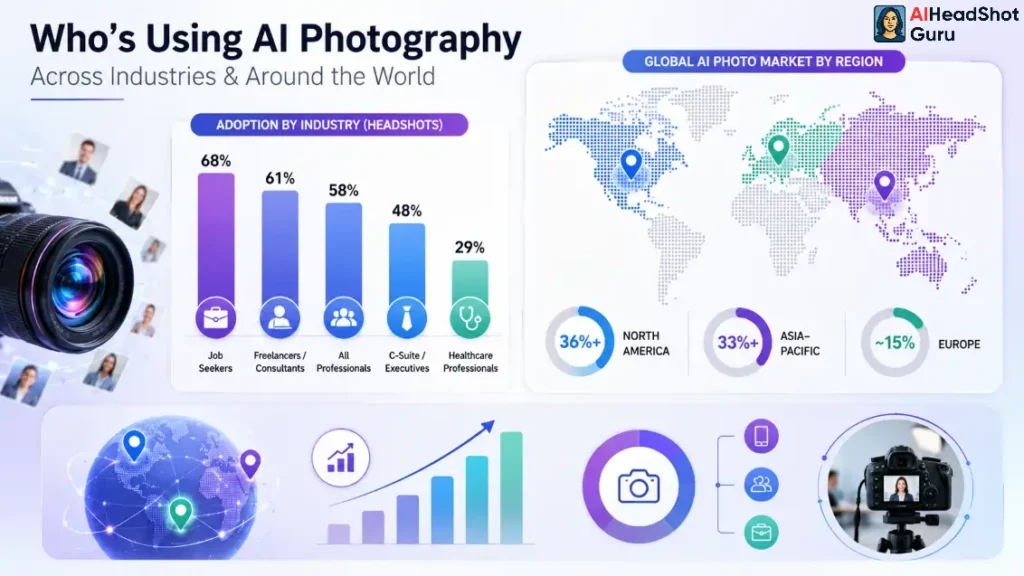
| Job Seekers | 68% |
| Freelancers/Consultants | 61% |
| All Professionals | 58% |
| C-Suite/Executives | 48% |
| Healthcare Professionals | 29% |
Geographic Split (AI Photo Market)
North America holds 36%+ of global AI market revenue and remains the dominant force in both AI headshots and product photography. The US market may approach $300 billion across all AI sectors by 2026.
Asia-Pacific is the fastest-growing region. Driven by smartphone penetration, a booming creator economy, and markets that never built traditional photography infrastructure at scale — APAC is projected to post a 33%+ CAGR through 2032 in AI image editing specifically.
Europe sits at a measured but consistent pace — $465 million in AI-generated photo editing in 2024 — with GDPR and AI transparency regulations shaping how adoption plays out in the region.
Consumer Sentiment on AI-Generated Photography
Numbers don't mean much if consumers reject AI imagery outright. The data says they mostly don't.
The quality threshold matters more than the origin. When shown high-quality AI images without disclosure, 60% of consumers reacted neutrally or positively after being told they were AI-generated. The backlash risk is low when execution quality is high.
AI Photography Market Forecast: 2026 to 2034
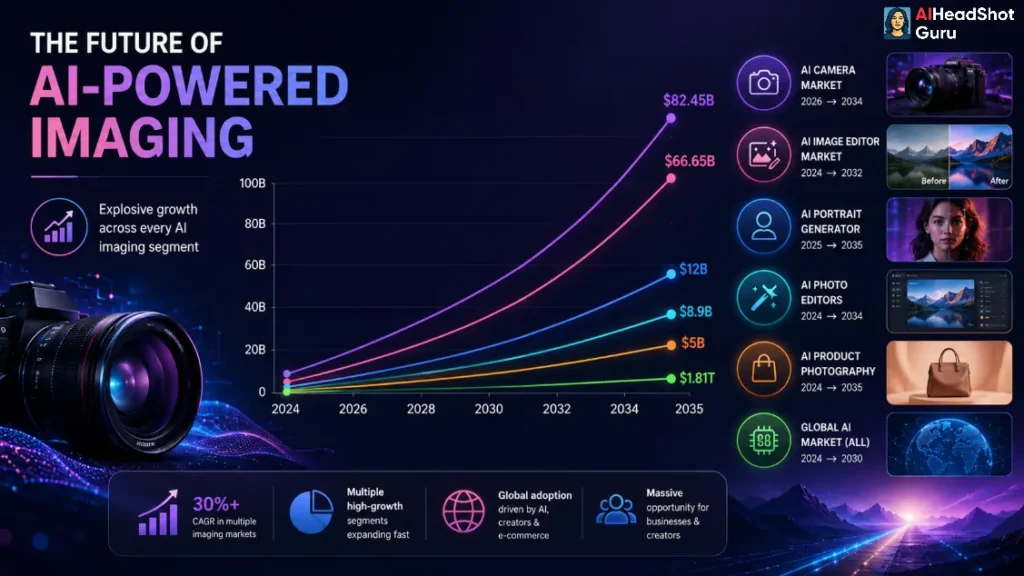
The numbers beyond 2026 tell the long-term story.
The AI creative market is not a single segment growing in isolation — it's multiple overlapping markets (headshots, product photography, portrait generation, image editing, AI cameras) each posting double-digit compound growth simultaneously.
The combined total addressable market for AI photography-adjacent tools in 2030 will comfortably exceed $100 billion.
Frequently Asked Questions
What is the AI photography market size in 2026?
The AI photography market spans multiple segments. The AI photo editors segment alone is on a trajectory from $2.1B (2024) to $8.9B (2034). The broader AI image editor market hit $7.77B in 2024 and is heading toward $66.65B by 2032. The AI headshot market specifically is projected to surpass $450 million in 2026.
What is the CAGR of the AI portrait generator market?
The AI portrait generator market is growing at a 19.4% CAGR, from $2.03 billion in 2025 to a projected $12 billion by 2035, according to WiseGuy Reports.
How fast is the AI product photography market growing?
The AI product photography market is growing at a 24.5% CAGR, from $450 million in 2024 to a projected $5 billion by 2035 — one of the fastest growth rates in any AI creative subcategory.
How much does an AI headshot cost vs. traditional photography?
AI headshots typically cost $20–$50 for 50–100 generated images. Traditional photography runs $250–$300 at the median, with premium photographers charging $600–$1,200+. The cost reduction is 80–95%.
Which region leads AI photography adoption?
North America leads with 36%+ of global AI market revenue. Asia-Pacific is growing fastest, with a projected CAGR of 33%+ in AI image editing through 2032, driven by eCommerce expansion and mobile-first markets.
Can recruiters tell if a headshot is AI-generated?
Studies show recruiters correctly identify AI headshots only 34–39.5% of the time — barely above random chance. 89% of recruiters say they care about photo quality, not whether a human or an AI created it.
How many AI images are generated daily?
Approximately 34 million AI-generated images are created every day globally. Over 15 billion AI images have been created since 2022.
What industries are slowest to adopt AI headshots?
Healthcare professionals show the lowest adoption at 29%, linked to institutional trust standards and regulatory sensitivity in the industry.

The Bottom Line on AI Photography Market Statistics 2026
The AI photography market in 2026 is not a projection — it's a documented, multi-billion dollar reality across headshots, portrait generation, product photography, and image editing. Multiple segments are posting 15–30%+ CAGRs simultaneously.
Consumer acceptance is high, recruiter resistance is essentially non-existent, and the cost advantages are so significant they're hard to argue against. The AI headshot industry alone grew from $180M to $420M+ in just three years.
The AI portrait generator market is on its way to $12B by 2035. And eCommerce brands processing thousands of product images are saving 60–83% on visual content costs without sacrificing quality. The numbers are in — and they're pointing in one direction.